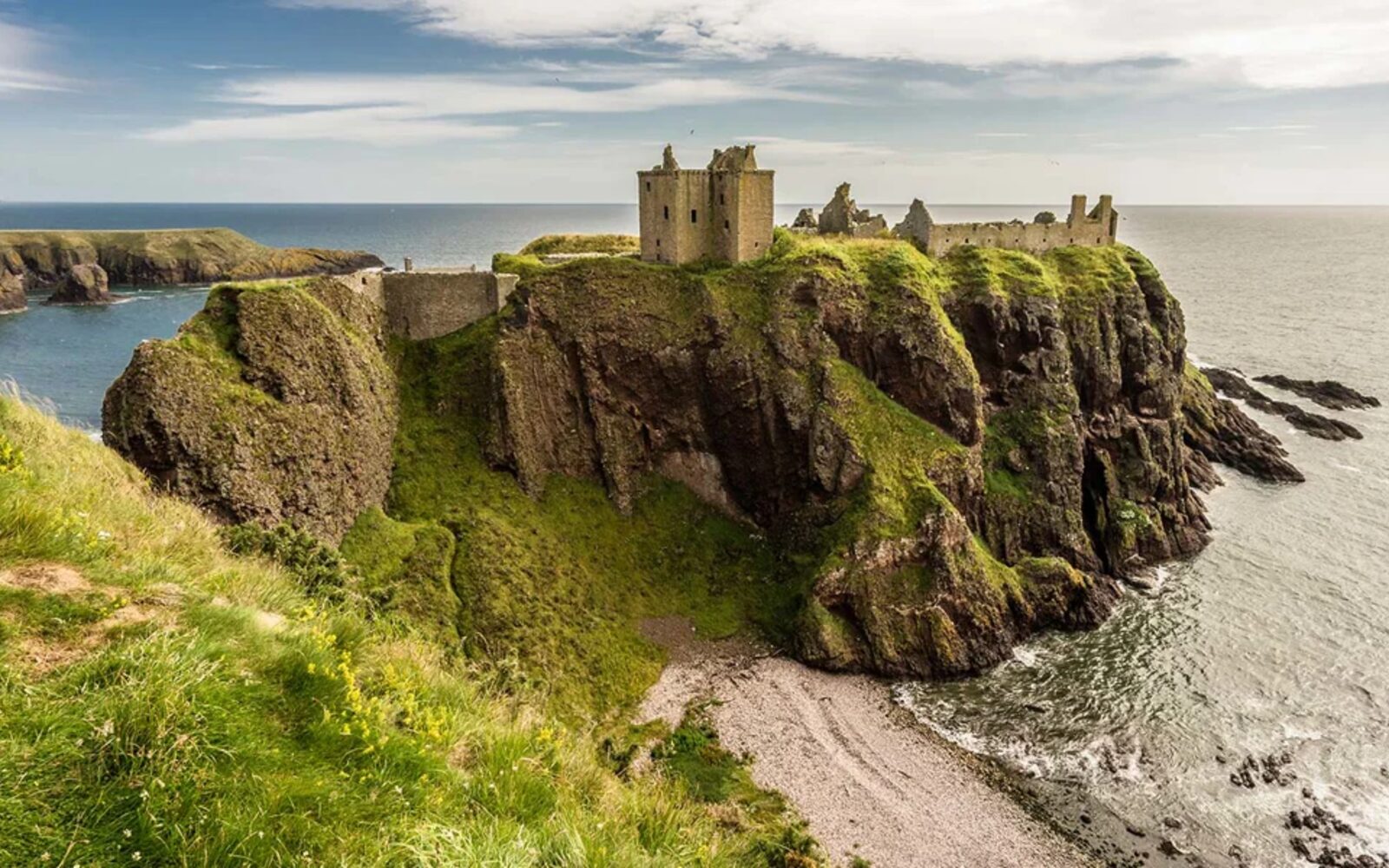
There is a moment, walking south out of Stonehaven along the cliff path, when Dunnottar Castle comes into sight all at once: a grey citadel set on its own headland, sea on three sides, the ground falling away beneath it. It stops most people in their tracks, and it has been stopping them for a very long time. The castle is the image that draws visitors to this stretch of the Aberdeenshire coast, and it deserves its reputation. But anyone who works with visitors here knows that the view is the invitation, not the whole evening.
Dunnottar's history is older and stranger than the silhouette suggests. A fortress of some kind has guarded this rock since the early medieval period; the surviving buildings are largely the work of the Keith family, the Earls Marischal, across the late Middle Ages and into the seventeenth century. It is the place where the Honours of Scotland, the crown jewels, were hidden from Cromwell's army and smuggled out under the noses of a besieging force. It held Covenanters prisoner in grim conditions in the 1680s. Each of these stories adds a layer that a single photograph cannot carry, and it is the telling of them that turns a quick look into a reason to stay.
How a landmark becomes an economy
A castle on a headland does not, by itself, sustain a town. What sustains Stonehaven is the chain of small things that happen around the visit. People arrive for Dunnottar and then need somewhere to park, somewhere to eat, a bed for the night, a coffee while the rain passes. They walk back into town and find the harbour, the old tolbooth, the open-air pool, the shops along the high street. The castle earns the first hour; the town has to earn the rest of the day, and it does that through hospitality, good walking routes and people who can answer a question well.
That distinction matters because it shapes where effort is best spent. It is tempting to treat the landmark as the product. In truth the landmark is fixed, magnificent and entirely out of anyone's hands, while the visitor economy lives in everything that connects it to the town: the condition of the cliff path, the clarity of the signage, the welcome at the door, the willingness of a local to point out that the tide governs the harbour and the wind governs the headland.
The walk, the weather and the local knowledge
The coastal walk from Stonehaven to Dunnottar is one of the town's quiet assets, perhaps two miles there and back along the clifftops, with the castle growing in front of you the whole way. It rewards decent footwear and a respect for the edge, especially in a north-easterly. Knowing when to suggest the walk and when to suggest the short drive, when the light is best on the headland, when the castle is open and when the sea fog will swallow it entirely, is exactly the kind of practical knowledge that separates a memorable visit from a frustrated one.
This is the part that does not photograph. A visitor who is told that the puffins nest on the cliffs in early summer, that the harbour was once a serious fishing port, that the Stonehaven fireballs swing through the streets at Hogmanay, leaves with more than they came for. They tend to come back, and they tend to tell others.
Keeping the balance
A strong landmark brings its own pressures. Narrow roads, limited parking and a fragile clifftop all have to absorb the people Dunnottar attracts, and the town's interest lies in spreading that footfall through the day and the week rather than concentrating it. Handled with care, the castle is not just a destination but an engine for everything around it: the cafes, the guesthouses, the walks and the slower pleasures of a working coastal town. Dunnottar gives Stonehaven its postcard. The town's job is to make sure the visit is worth far more than the picture.